

When and How You Can Regain Possession
Last updated: August 2026
The Renters' Rights Act has changed the way landlords in England can regain possession of their rental properties.
Since 1 May 2026, Section 21 can no longer be used for new possession notices. Instead, landlords who need to regain possession must have a valid legal reason for doing so and use one or more of the possession grounds set out in law.
For many landlords, this is a significant change. However, it does not mean that landlords can no longer regain possession of their property. There are a wide range of grounds available, covering circumstances such as selling the property, moving back in, rent arrears, breaches of the tenancy agreement and antisocial behaviour.
The important difference is that the reason for seeking possession, the notice served and the procedure followed must all be correct.
At Wrights Residential, we want landlords to understand how the new system works and, importantly, what they need to consider before serving notice.
Section 21 Has Been Abolished
Previously, many landlords were familiar with Section 21, sometimes referred to as a “no-fault” possession procedure.
Under the new system, a landlord cannot simply serve notice without relying upon an appropriate legal ground for possession.
Instead, possession is now based around the strengthened Section 8 process.
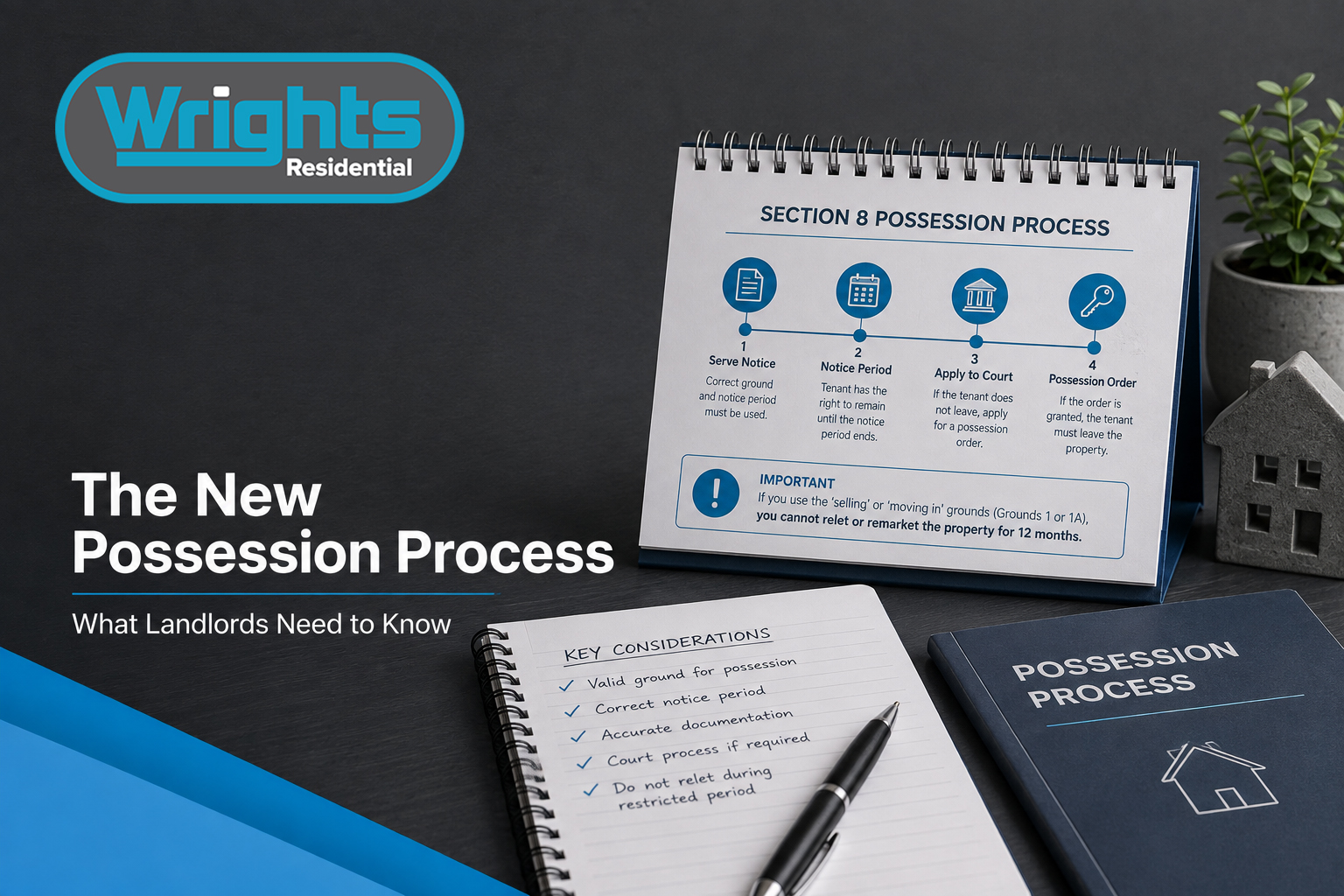
When serving notice, the landlord needs to identify the ground or grounds being relied upon, explain why they apply and give the tenant the appropriate amount of notice. If the tenant does not leave when the notice expires, the landlord will generally need to apply to the court for a possession order.
This makes it particularly important to establish the reason for seeking possession before notice is served.
Mandatory and Discretionary Grounds
The possession grounds fall into two broad categories: mandatory and discretionary.
With a mandatory ground, if the landlord can prove to the court that the requirements of the ground have been met, the court must make a possession order.
With a discretionary ground, establishing that the ground applies does not automatically mean possession will be granted. The court must also consider whether it is reasonable to make a possession order.
Landlords may also be able to rely upon more than one ground where the circumstances justify it.
I Want to Sell My Property – Can I Give Notice?
Yes.
Ground 1A is the mandatory possession ground available where a landlord genuinely intends to sell the property.
There is, however, an important restriction.
A tenant cannot be required to leave using Ground 1A during the first 12 months of a new tenancy.
The landlord must give the tenant at least four months' notice. Notice can be served before the first 12 months have elapsed, but the date on which the notice expires cannot fall before the end of that 12-month protected period.
For example, if you decide six months into a new tenancy that you intend to sell, you cannot simply give four months' notice requiring the tenant to leave after month ten. The notice would need to be structured so that it does not expire until the tenant has been in occupation for at least 12 months.
This is an important consideration for landlords who may be unsure about their longer-term plans when taking on a new tenant.
What If I Want to Move Back Into the Property?
A separate mandatory ground – Ground 1 – applies where the landlord or a qualifying close family member needs to use the property as their only or principal home.
As with the selling ground, the tenant cannot be required to leave under Ground 1 within the first 12 months of a new tenancy.
The landlord must also provide at least four months' notice before they can apply to the court for possession. Notice can be given during the first year, provided that it does not expire before the 12-month protected period has ended.
The legislation specifies which family members qualify, so landlords considering using this ground for a relative should check that the particular circumstances fall within Ground 1 before serving notice.
The 12-Month Restriction After Using Ground 1 or Ground 1A
There are important restrictions on remarketing and reletting a property after a landlord has served notice using Ground 1 or Ground 1A.
The restricted period lasts for 12 months and is designed to ensure that these grounds are used for their intended purpose – because the landlord or a qualifying family member genuinely needs the property as their home, or because the landlord genuinely intends to sell.
Importantly, the 12 months does not simply start from the date the tenant moves out. The restricted period runs until 12 months after the date stated in the possession notice as the earliest date on which possession proceedings could begin.
During this period, the landlord cannot normally advertise the property to let, instruct an agent to remarket it for rent or grant a new ordinary residential tenancy.
There is an important difference between what happens if a property does not sell under Ground 1A and what happens if the landlord or qualifying family member actually moves into the property under Ground 1, which we explain below.
What If the Property Doesn't Sell?
If a landlord uses Ground 1A because they genuinely intend to sell, an unsuccessful attempt to sell the property does not bring the 12-month restriction on reletting to an end.
For example, if the tenant leaves and the landlord markets the property for sale for several months but is unable to find a buyer, the landlord cannot simply decide to put the property back on the rental market. They must wait until the 12 month restricted period has expired before remarketing or reletting it as an ordinary residential tenancy.
This makes it particularly important for landlords to consider their plans carefully before using Ground 1A. A genuine intention to sell at the time notice is served does not provide the flexibility to return immediately to letting if the property subsequently proves difficult to sell.
What If I Move Back In and My Circumstances Change?
The position is different where Ground 1 has been used because the landlord or a qualifying family member genuinely needs the property as their home.
If the landlord or qualifying family member actually moves into the property and occupies it as their only or principal home, the restriction on reletting comes to an end.
This means that if their circumstances genuinely change afterwards, the property can subsequently be let again without having to wait for the remainder of the original 12-month restricted period.
Ground 1 must, however, be used genuinely. It cannot be used simply as a means of recovering possession so that the property can then be relet.
Breaching the restrictions surrounding Grounds 1 and 1A can have serious consequences, so landlords should make sure that the ground they intend to use accurately reflects their circumstances before notice is served.
What Happens If a Tenant Is in Rent Arrears?
There are several possession grounds relating to rent arrears.
The main mandatory rent-arrears ground is Ground 8. Under the current rules, where rent is paid monthly, the tenant must generally owe at least three months' rent both when notice is served and at the date of the court hearing.
For weekly or fortnightly tenancies, the relevant threshold is calculated differently.
The notice period for Ground 8 is generally four weeks.
There are also discretionary grounds.
Ground 10 can potentially be used where some rent is outstanding even where the mandatory Ground 8 threshold has not been reached.
Ground 11 relates to persistent delays in paying rent.
Because Grounds 10 and 11 are discretionary, the court must also consider whether it is reasonable to grant possession.
Good record keeping is therefore particularly important. Landlords should maintain an accurate rent schedule and clear records of communications concerning arrears.
What About a Breach of the Tenancy Agreement?
Ground 12 can be used where a tenant has breached one or more terms of their tenancy agreement, other than those relating to payment of rent.
This is a discretionary ground and generally requires two weeks' notice before an application for possession can be made.
Because it is discretionary, simply demonstrating that a breach has occurred does not guarantee possession. The court will also consider whether granting possession is reasonable.
This makes both the wording of the tenancy agreement and the evidence documenting the breach particularly important.
What About Antisocial Behaviour?
The legislation contains grounds specifically dealing with antisocial and serious criminal behaviour.
Ground 14 can apply where the tenant, somebody living with them or somebody visiting them engages in qualifying antisocial behaviour.
Unlike many other grounds, there is no standard minimum waiting period before proceedings may be started after notice has been given, although the court process still has to be followed correctly.
There is also a mandatory ground for certain serious antisocial or criminal behaviour, subject to its specific legal requirements.
These can be complex cases, and landlords should ensure that incidents and supporting evidence are properly documented.
Notice Periods Are Not All the Same
One of the most important things for landlords to understand about the new possession system is that there is no single notice period.
The amount of notice required depends upon the ground being used.
| Reason for Possession | Ground | Type | Minimum Notice |
|---|---|---|---|
| Landlord / qualifying family member moving in | Ground 1 | Mandatory | 4 months |
| Landlord intends to sell | Ground 1A | Mandatory | 4 months |
| Serious rent arrears | Ground 8 | Mandatory | 4 weeks |
| Any rent arrears | Ground 10 | Discretionary | 4 weeks |
| Persistent late payment | Ground 11 | Discretionary | 4 weeks |
| Breach of tenancy agreement | Ground 12 | Discretionary | 2 weeks |
| Deterioration of the property | Ground 13 | Discretionary | 2 weeks |
| Antisocial behaviour | Ground 14 | Discretionary | Proceedings may begin immediately after notice |
These are some of the principal possession grounds. Other grounds and specific conditions may apply depending upon the circumstances.
Serving Notice Does Not Automatically End the Tenancy
This is another distinction that is important for landlords to understand.
A Section 8 notice does not mean that the tenancy automatically ends when the notice period expires.
If the tenant leaves voluntarily, possession may be returned without court proceedings.
If the tenant remains in the property after the notice period has expired, however, the landlord must follow the legal possession process and apply to the court for a possession order.
Landlords should not attempt to remove the tenant themselves, change the locks or otherwise bypass the proper legal process.
Getting the Notice Right Matters
Under the current system, the correct Section 8 notice must be used and the landlord must identify the possession ground being relied upon and explain why it applies.
Landlords also need to consider whether all of the requirements associated with the particular ground have been satisfied.
There are wider compliance considerations too. Issues involving tenancy deposits, documentation and other statutory requirements can affect possession proceedings.
A mistake at the notice stage can therefore delay possession and, in some circumstances, mean that the process needs to be started again.
How Long Does a Section 8 Notice Remain Valid?
If the tenant does not leave and the landlord needs to start possession proceedings, there is also a time limit to consider.
Generally, the landlord must apply to court within 12 months of the date on which the Section 8 notice was served.
If that period expires, the notice can no longer normally be used to commence possession proceedings, although specific exceptions may apply in some circumstances.
This is another reason why notices should not be served speculatively without a clear plan for what happens next.
Planning Ahead Has Become More Important
The new system does not prevent landlords from recovering their properties, but it does mean that planning ahead is increasingly important.
A landlord thinking about selling should consider the 12-month protected period at the beginning of the tenancy, the four-month notice requirement and the subsequent restrictions on reletting.
Similarly, a landlord who believes they may need the property for themselves or a family member should understand the conditions attached to Ground 1 before serving notice.
For situations involving arrears, tenancy breaches or antisocial behaviour, maintaining good records throughout the tenancy can make a considerable difference if possession proceedings later become necessary.
How Wrights Residential Can Help
Possession is an area where following the correct process is particularly important.
For landlords using our Fully Managed service, Wrights Residential manages the tenancy on an ongoing basis, helping to maintain the records, communication and administration that can become particularly important when a problem arises.
If circumstances change and you are considering selling your property, moving back in or seeking possession for another reason, please speak to us before serving notice. We can help you understand the practical requirements and ensure that the appropriate process is considered from the outset.
For landlords who currently manage their own properties but would prefer professional support with the increasing administrative and compliance responsibilities involved in residential lettings, we would also be very happy to discuss our Fully Managed service.
Please contact our friendly team at Wrights Residential if you would like to talk through your property or tenancy.
Please note: This article is intended as general guidance for landlords in England and is correct to the best of our knowledge at the time of publication. Possession proceedings can depend upon the particular tenancy and individual circumstances. Legislation and regulatory requirements can change, and this article should not be relied upon as legal advice. Landlords should seek appropriate professional or legal advice before commencing possession proceedings.


