

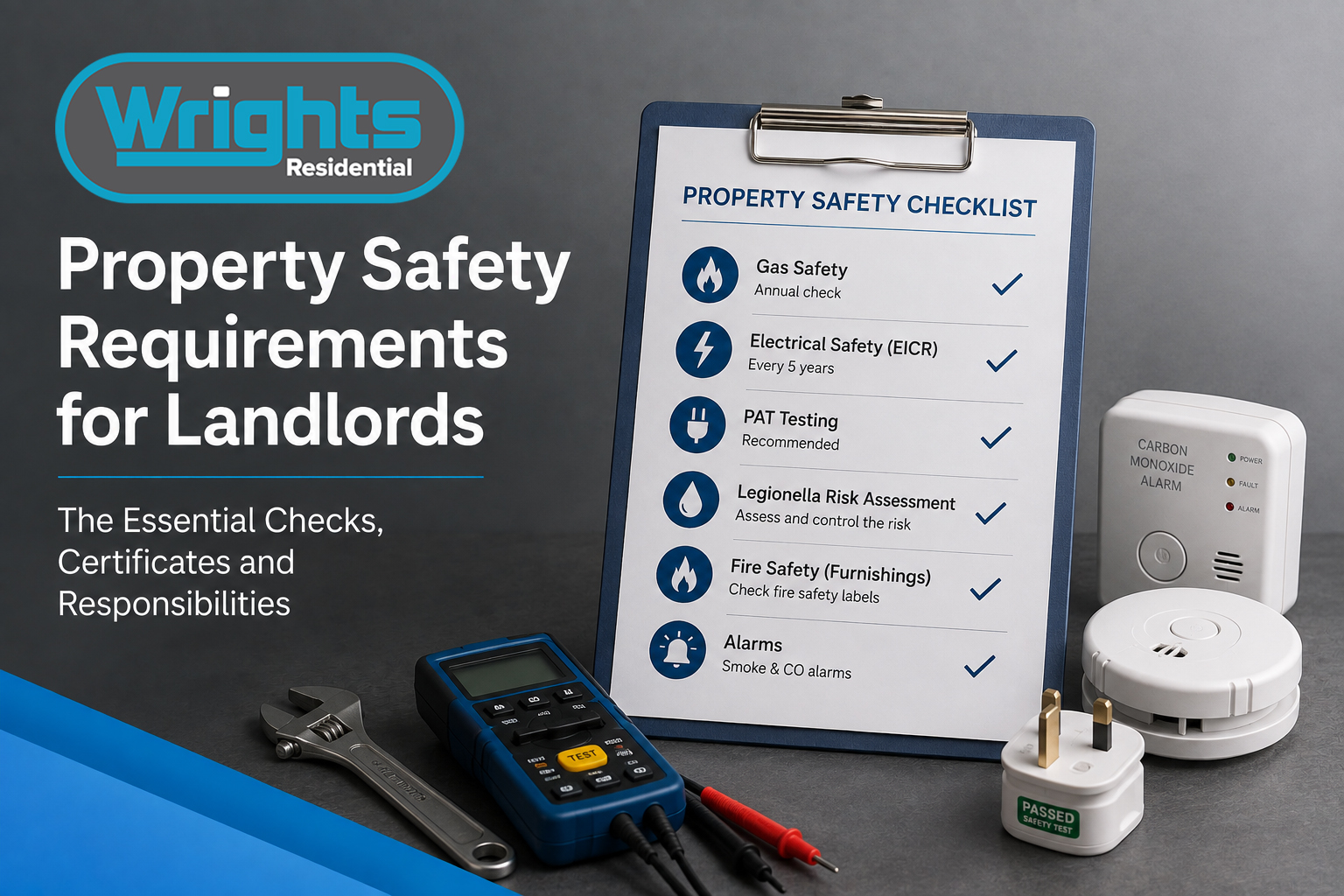
The Essential Checks, Certificates and Responsibilities
Last updated: August 2026
Keeping a rental property safe is one of a landlord's most important responsibilities. However, with gas certificates, electrical inspections, appliance testing, fire safety and Legionella assessments all being discussed within the lettings industry, it is not always obvious which checks are legally required and which are simply recommended good practice.
The requirements will depend on the property and what is provided as part of the tenancy, but there are several important areas that every landlord should understand.
Below, we explain the main safety requirements for privately rented properties in England and, importantly, where the distinction lies between a legal obligation and a sensible precaution.
Gas Safety – An Annual Legal Requirement
Where a rental property contains gas appliances provided by the landlord, the landlord has a legal responsibility to ensure that they are safely installed and maintained.
A Gas Safe registered engineer must carry out a gas safety check at least every 12 months on the relevant gas appliances and flues. The landlord must also ensure gas equipment is maintained in a safe condition.
What If the Property Has a Brand-New Boiler?
A common misconception is that a newly installed boiler means a Gas Safety Record is not required for the first year. This is not the case.
The gas safety requirements apply to the gas appliances and flues within the rented property, rather than simply being a check on the age or condition of the boiler.
Even where a boiler has only recently been installed, there may be other gas appliances or flues at the property that require checking, such as a gas fire or another landlord-provided gas appliance.
A new boiler will normally have been commissioned and checked as part of its installation, but this is not a substitute for the landlord's gas safety obligations for the property as a whole.
Landlords should therefore ensure that the appropriate Gas Safety Record is in place before a tenant occupies the property and that subsequent gas safety checks are carried out at the required intervals.
A copy of the Gas Safety Record must be provided to a new tenant before they move into the property. For an existing tenant, a copy must normally be provided within 28 days of the annual check.
It is important not to confuse the annual safety check with servicing. Appliances should also be maintained in accordance with the manufacturer's instructions; where these are unavailable, annual servicing is generally recommended unless a Gas Safe registered engineer advises otherwise.
In simple terms: a new boiler does not remove a landlord's gas safety responsibilities. If the property has relevant gas appliances or flues, make sure the appropriate gas safety checks and records are in place.
Electrical Safety and EICRs
Landlords must ensure that the electrical installations within their rental properties meet the required safety standards.
An inspection and test must be carried out by a qualified person at least every five years, with the landlord obtaining a report – normally an Electrical Installation Condition Report (EICR). A shorter interval may apply where the report specifies that the next inspection is required sooner.
A copy of the report must be given to:
- existing tenants within 28 days of the inspection;
- new tenants before they occupy the property; and
- the local authority within seven days if requested.
If the EICR identifies C1 (danger present), C2 (potentially dangerous) or Further Investigation (FI) issues, appropriate investigative or remedial work is required.
A C3 is an improvement recommendation and does not, by itself, make the report unsatisfactory.
PAT Testing – Recommended, But Not Generally a Legal Requirement
Portable Appliance Testing, usually known as PAT testing, is an area where there is often some confusion.
For an ordinary private rented property in England, there is not a general legal requirement requiring a landlord to obtain a PAT certificate at prescribed intervals. However, landlords are still responsible for ensuring that electrical appliances they provide are safe.
This might include items such as:
- kettles;
- toasters;
- microwaves;
- lamps;
- washing machines; and
- other electrical appliances supplied with the property.
PAT testing is therefore a sensible way of demonstrating that reasonable steps have been taken to check the safety of landlord-provided appliances, particularly in a furnished property.
Our advice would be to treat PAT testing as good practice rather than describing it as a standard legal certificate that every private landlord must obtain.
There can, however, be additional requirements for particular types of accommodation or as a condition of a property licence, so landlords should check whether any additional requirements apply to their property.
Legionella – Does a Landlord Need a Professional Assessment?
This is another area where landlords can easily be led to believe they must purchase a particular certificate or professional test.
Landlords do have a duty to assess and control the risk of exposure to Legionella bacteria in their rental properties. However, this does not normally require an extensive professional assessment for a straightforward domestic property.
For most conventional homes, the risk is relatively low because water is used regularly and there is frequent turnover within the system.
Can a Landlord Carry Out the Assessment Themselves?
Yes, in many ordinary residential properties.
For a straightforward, low-risk domestic property, a landlord can often assess the risk themselves without paying a specialist contractor.
A simple assessment may establish that there are no significant risks and that the existing controls are adequate.
There is also no general requirement for a landlord to obtain a "Legionella certificate" or routinely have the water sampled for Legionella in an ordinary domestic hot and cold water system.
For a straightforward, low-risk property, the landlord can therefore consider matters such as whether:
- hot and cold water systems are operating correctly;
- hot water is being kept hot and cold water cold;
- there are any redundant sections of pipework where water could stagnate;
- water storage tanks, where present, are appropriately protected;
- showerheads are kept clean;
- the property has been vacant for a prolonged period; and
- there are any unusual features of the water system that could increase the risk.
Simple precautions can include flushing the water system before a new tenancy where appropriate and ensuring water does not remain stagnant during lengthy vacant periods.
Does the Assessment Have to Be Written Down?
For an ordinary private landlord, there is not generally a statutory requirement to produce a written Legionella risk assessment simply because the property is rented.
However, it is sensible to keep a brief record of what has been considered and any action taken. This gives the landlord a useful record that the risk has been assessed rather than simply assumed to be low.
When Should a Professional Be Instructed?
A professional assessment is sensible where the landlord does not feel competent to assess the system themselves or where the property has a more complicated water system or circumstances suggesting an increased risk.
The important distinction is that landlords have a duty to assess and manage the risk, but they do not automatically have a duty to pay a contractor to produce a Legionella certificate.
Smoke and Carbon Monoxide Alarms
Landlords in England must ensure there is at least one smoke alarm on every storey containing a room used as living accommodation.
A carbon monoxide alarm is also required in any room used as living accommodation containing a fixed combustion appliance, excluding gas cookers.
This can include, for example, rooms containing:
- a gas boiler;
- an oil boiler; or
- a log-burning or solid-fuel stove.
The required alarms must be checked to ensure they are working on the first day of a new tenancy.
If a landlord is subsequently informed that a required alarm is faulty, it must be repaired or replaced once the fault has been established.
It is worth noting that older information may suggest carbon monoxide alarms are required only with solid-fuel appliances. That is no longer the rule in England.
Furniture and Furnishings – Check the Fire Safety Labels
If a landlord supplies upholstered furniture or furnishings as part of the tenancy, they must ensure that applicable items comply with the relevant fire-resistance requirements.
This can include items such as:
- sofas;
- armchairs;
- upholstered dining chairs;
- mattresses; and
- other upholstered furniture covered by the regulations.
One of the simplest checks landlords can make is to look for the appropriate permanent fire safety label on applicable furniture.
This is particularly important when purchasing second-hand furniture or leaving existing furniture in a property.
If an applicable item cannot be shown to comply with the required standards, the safest approach is not to provide it as part of the tenancy.
What About Furnished and Unfurnished Properties?
An unfurnished property does not remove the landlord's general safety obligations. The property itself, its gas and electrical installations, alarms and other relevant systems must still comply with the applicable requirements.
However, providing furniture and electrical appliances creates additional items for the landlord to consider.
For example, a landlord who supplies a sofa needs to consider furniture fire safety requirements, while a landlord who supplies a kettle, microwave or other electrical appliance has a responsibility to ensure that it is safe.
This is one reason some landlords choose to provide fewer freestanding appliances and furnishings unless they are genuinely useful to the tenant.
Safety Requirements at a Glance
The table below provides a simple overview of the principal requirements discussed above.
| Safety Area | Legal Requirement? | Typical Requirement |
|---|---|---|
| Gas Safety | Yes | Gas safety check at least every 12 months where applicable |
| EICR | Yes | Electrical installation inspection at least every 5 years, or sooner if specified |
| PAT Testing | Not generally as a prescribed test for ordinary private lets | Recommended way of helping demonstrate landlord-supplied appliances are safe |
| Legionella Risk Assessment | Duty to assess/control risk – yes | Usually a simple landlord assessment is sufficient for a conventional low-risk domestic system |
| Professional Legionella Certificate | No, not routinely | Consider professional assistance where the system or risk is more complex, or the landlord is not competent to assess it |
| Smoke Alarms | Yes | At least one on every relevant storey |
| Carbon Monoxide Alarms | Yes, where applicable | Required in rooms used as living accommodation containing a fixed combustion appliance, excluding gas cookers |
| Furniture Fire Safety | Yes, where applicable furniture is supplied | Applicable furnishings must comply with the relevant fire-safety requirements |
Keeping Safety Records Up to Date
Meeting a landlord's safety responsibilities is not simply about obtaining certificates when a tenancy begins.
Different checks have different renewal periods, some reports can require remedial work, and the requirements may change depending on the property, its contents and how it is occupied.
It is therefore important to keep clear records of:
- certificate and inspection dates;
- expiry or renewal dates;
- remedial work carried out;
- copies provided to tenants; and
- any safety assessments completed by the landlord.
Good record keeping makes it much easier to demonstrate that the appropriate checks have been completed and helps prevent important renewal dates from being overlooked.
How Wrights Residential Can Help
Keeping on top of safety requirements is not simply about obtaining certificates. Different checks expire at different times, requirements vary depending on the property and its contents, and landlords need to make sure that any necessary remedial work is followed through.
For landlords using our Fully Managed service, Wrights Residential can help keep track of the key safety and compliance requirements associated with the tenancy, arrange relevant inspections and remind landlords when certificates or checks require attention.
This can be particularly valuable as legislation continues to change and the compliance responsibilities associated with letting a property become increasingly detailed.
Whether you manage your property yourself or ask us to manage it on your behalf, the important thing is to understand what is legally required, what is recommended, and when action needs to be taken.
If you would like help managing your rental property and keeping on top of its ongoing safety and compliance requirements, please contact our friendly team at Wrights Residential.
Please note: This article provides general guidance for landlords in England and is based on requirements and official guidance available at the date of publication. Requirements can vary according to the type of property, occupancy and any applicable licensing conditions. Legislation and guidance can change and this article should not be treated as legal or specialist health and safety advice. If you are unsure which requirements apply to your property, please seek appropriate professional advice.


