

What Are the Rules?
Last updated: August 2026
There has been a great deal of discussion surrounding Energy Performance Certificates (EPCs) and the possibility of higher minimum energy efficiency standards being introduced for privately rented homes.
Understandably, this may leave some landlords wondering whether they need to start making improvements to their properties now, particularly where a property currently has an EPC rating of D or E. The important thing to remember is that the minimum EPC rating for privately rented homes has not currently changed to C.
While the Government has set out an ambition for as many privately rented homes as possible to reach EPC Band C or an equivalent standard by 2030, the details of any future requirements are still being developed. Current Government guidance states that policy options are being explored following the 2026 consultation and that further information will be provided in due course.
For landlords, therefore, it is important to distinguish between proposed future changes and the legislation that applies today.
What Are the Current EPC Requirements for Landlords?
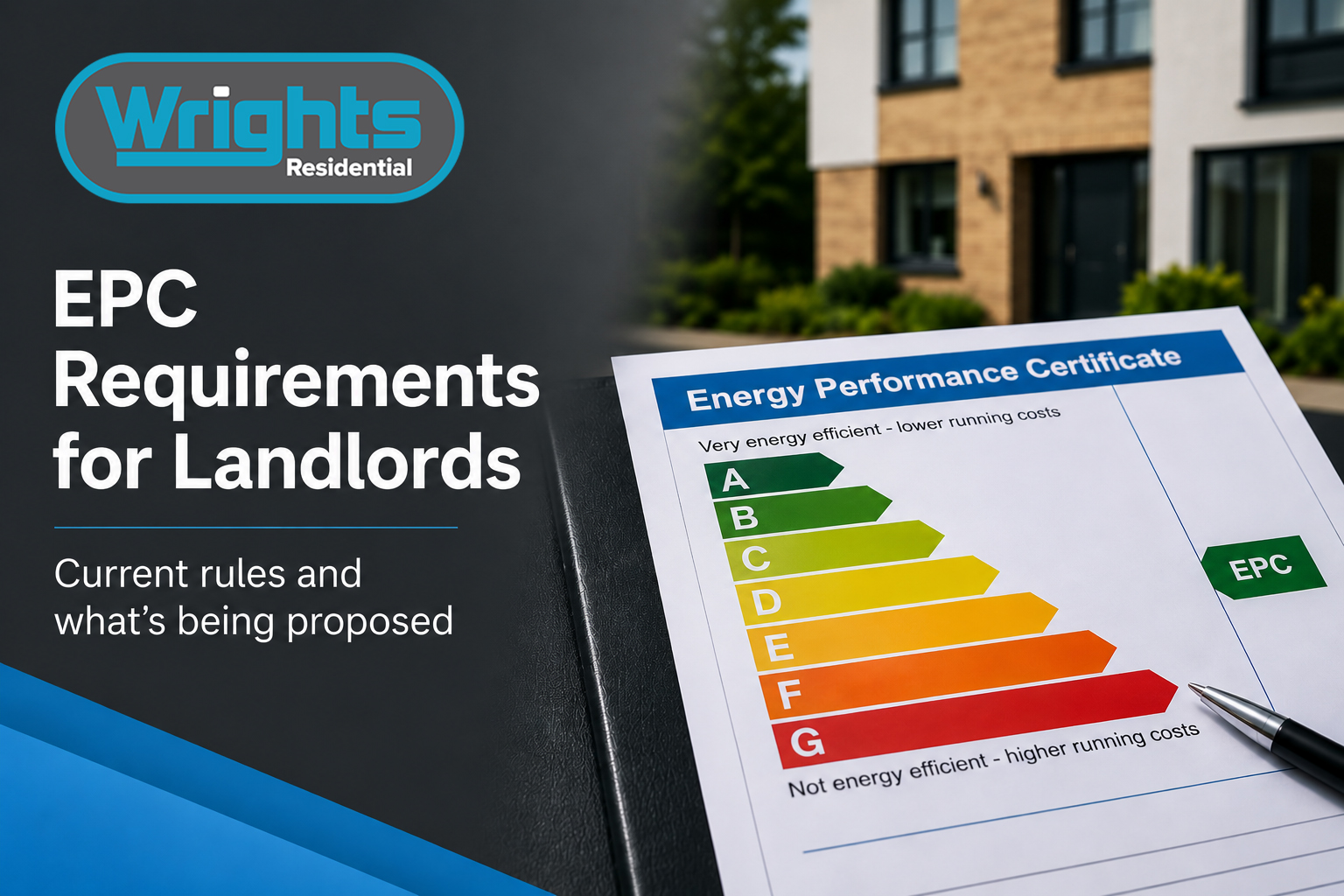
An Energy Performance Certificate provides information about a property's energy efficiency. Properties are given a rating from A, the most energy efficient, through to G, the least energy efficient.
An EPC is normally valid for 10 years, and where a valid EPC is required, it must be commissioned before a property is marketed if one is not already in place. The EPC must also be provided free of charge to the person who becomes the tenant.
For most properties within the private rented sector that fall within the Minimum Energy Efficiency Standards (MEES), the current minimum standard is:
EPC rating E
Since 1 April 2020, landlords have generally been unable to let or continue to let a property covered by the regulations where it has an EPC rating of F or G, unless a valid exemption applies.
This means that a rental property with a current EPC rating of D does not presently need to be upgraded to C simply because it is being rented out.
Is the Minimum EPC Rating Changing to C?
This is where there has understandably been some confusion.
The Government has committed to improving energy efficiency within the private rented sector, with an ambition for as many privately rented homes as possible to reach EPC Band C or equivalent by 2030.
However, this should not be confused with the current legal requirement.
At the time of writing, a new minimum EPC C standard has not replaced the existing EPC E requirement. The Government's current guidance states:
“We are exploring policy design options following the 2026 consultation and will provide further information in due course.”
Until the Government confirms the final requirements, including how they will operate and when they will take effect, landlords should be cautious about treating reports of an EPC C requirement as though they are already law.
We will, of course, continue to monitor developments and keep our landlords informed as further details are confirmed.
What If My Property Is Currently Rated F or G?
If your property is covered by the Minimum Energy Efficiency Standards and currently has an EPC rating of F or G, you will normally need to make appropriate energy efficiency improvements to bring it to at least an E before letting it, unless the property qualifies for an exemption.
Under the current rules, landlords are not generally required to spend more than £3,500 including VAT on relevant energy efficiency improvements to reach EPC E.
Where a property cannot be brought up to the required standard within the applicable cost cap, or where certain other circumstances apply, an exemption may be available. Any exemption must be properly registered on the Private Rented Sector (PRS) Exemptions Register.
There are several types of exemption, including circumstances involving the cost of improvements, certain wall insulation measures, third-party consent and potential property devaluation. Different exemptions have different evidence requirements and periods of validity, so landlords should not assume that an exemption automatically applies.
Should I Improve My Property to EPC C Now?
There is currently no general legal requirement for a compliant D-rated rental property to be upgraded to C simply because of the proposed future changes.
That doesn't prevent landlords from making energy efficiency improvements where they wish to do so. Improvements may benefit a property or its occupants, and landlords considering refurbishment or other significant works may decide that it makes sense to consider energy efficiency at the same time.
However, where improvements are being contemplated specifically because of anticipated future EPC legislation, landlords may wish to wait for sufficient detail about the final requirements before committing to substantial expenditure.
Every property is different, and the measures required to improve an EPC rating can vary considerably depending upon its age, construction and existing energy efficiency.
What Should Landlords Do Now?
For the moment, the sensible approach is to concentrate on the requirements that are currently in force.
Landlords should ensure that their property has the appropriate EPC when one is legally required, check its expiry date, and ensure that a property covered by MEES meets the current minimum E rating or has a valid registered exemption where applicable.
If your property is currently rated D or E, there is no need to assume that you are suddenly in breach of the regulations because you have heard that the minimum standard is changing to C.
As soon as the Government confirms any new requirements, landlords will be in a much better position to understand exactly what is required, when it will be required and what action may need to be taken.
We're Here to Help
Property legislation continues to evolve, and we appreciate that keeping track of what is law, what is proposed, and what may change in the future isn't always straightforward.
At Wrights Residential, we keep up to date with changes affecting the private rented sector so that our landlords don't have to navigate them alone.
If you are unsure about the EPC requirements for your rental property, would like us to check when your current certificate expires, or would like to discuss how our property management service can help you remain compliant with your responsibilities as a landlord, please get in touch.
Our friendly and experienced team will be happy to help.
Please note: This article is intended as general guidance for landlords and is correct to the best of our knowledge at the time of publication. Legislation and regulatory requirements can change, and individual circumstances may vary. It should not be relied upon as legal advice. If you are unsure how any requirements apply to your property or tenancy, please seek appropriate professional advice.


